
You Cannot Be Unhappy and Grateful at the Same Time
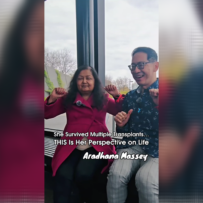
A Conversation on Organ Transplants, Faith, Family, and Resilience with Aradhana Massey
A conversation with Aradhana Massey about organ transplantation, gratitude, faith, immigration, family, resilience, healing, and community connection through the Sakura Project and danceScape.
There are conversations that stay with you long after they end.
Not because they are loud.
Not because they are dramatic.
But because they are honest.
Our recent conversation with Aradhana Massey as part of the Sakura Project became one of those moments—a dialogue about organ transplantation, grief, gratitude, culture, family, faith, healing, and what it means to continue moving forward through life’s uncertainties.
What began as an interview gradually became something more:
A reflection on resilience.
A reflection on connection.
A reflection on life itself.
🌸 “You’re Never Prepared…”
Aradhana spoke openly about the passing of her mother, who had been ill for several years.
Like many families, there had been time to process what was coming. And yet, when the moment finally arrives, logic and preparation often disappear.
She shared something simple, but deeply universal:
“You’re never prepared… even when you know it’s coming.”
Loss changes the emotional landscape around us in ways that are difficult to explain.
For Aradhana, the loss of her mother was also the loss of everyday connection:
- daily phone calls
- shared conversations
- familiar routines
- presence
And yet, throughout the conversation, gratitude continued to emerge as the thread connecting everything together.
🙏 Faith as Foundation
One thing became immediately clear during the interview:
Faith has been central throughout Aradhana’s life journey.
Her mother, a nurse from the age of sixteen in India, began and ended every day with scripture and prayer. That rhythm eventually became part of Aradhana’s own life as well.
“She never went to bed without reading her Bible. She never started her day without it.”
Faith, for her, is not simply belief.
It is grounding.
Direction.
Trust during uncertainty.
And perhaps most importantly—it is strength during difficult moments.
🏥 Living Through Organ Transplantation
A major part of Aradhana’s story involves her decades-long health journey.
Diagnosed with Type 1 diabetes at the age of eight, she learned early what it meant to navigate uncertainty and medical complexity.
Over time, her journey included:
- insulin dependency
- dialysis
- kidney failure
- organ transplantation
- recovery
- and continued resilience
Today, she lives with transplanted organs and is currently awaiting another kidney transplant.
But what stood out most was not simply the medical story itself.
It was her perspective on life.
⚡ “We Have a Donor. You Have Two Hours.”
One of the most striking moments in the interview came when she described receiving the transplant call.
“We have a donor for you. You have two hours.”
The moment felt surreal.
Standing in front of her closet, processing everything at once, she remembered thinking:
“What do I wear?”
Shock does not always appear dramatic.
Sometimes it appears quiet.
Still.
Human.
💔 The Emotional Complexity of Organ Donation
One of the most emotional parts of transplantation, she shared, was realizing that her life continued because another family experienced loss.
Her pancreas donor was a seventeen-year-old young man.
At the time, her own son was thirteen.
“A mother out there lost her son… so I could live.”
That realization stayed with her deeply.
In Canada, transplant recipients may write anonymous letters to donor families if both parties agree to participate in the process.
For Aradhana, this helped transform transplantation from a purely medical experience into a profoundly human one.
It became about connection.
Compassion.
And gratitude.
🌸 “You Cannot Be Unhappy and Grateful at the Same Time”
If there was one sentence that became the emotional center of the interview, it was this:
“You cannot be unhappy and grateful at the same time.”
This philosophy eventually inspired her ongoing “365 Days of Gratitude” practice, where she intentionally reflects daily on something meaningful, however small.
Importantly, gratitude is not denial.
She is not pretending life is easy.
She is choosing perspective.
Even difficult moments can still contain:
- meaning
- growth
- redirection
- connection
For her, gratitude is not passive positivity.
It is active awareness.
🌍 Immigration, Identity, and Belonging
Another important part of the conversation explored immigration and cultural identity.
Born in India, raised partly in England, and eventually settling in Canada, Aradhana spoke honestly about wanting to fit in as a child.
She described feeling:
- visibly different
- self-conscious about her accent
- uncertain about belonging
“You looked funny. You sounded funny.”
Like many immigrants and children of immigrants, adaptation often meant minimizing visible differences.
But with time came a different perspective.
As adults, many begin to revisit their parents’ sacrifices with deeper appreciation.
She reflected on the reality that her parents navigated:
- multiple countries
- rebuilding careers
- raising four children
- financial hardship
- cultural adaptation
…while continuing to support family and community around them.
🍲 Food, Family, and Community
Food appeared repeatedly throughout the interview—not simply as cuisine, but as connection.
Her parents operated an Indian restaurant in Toronto, where the entire family worked together:
- cooking
- preparing food
- serving others
- welcoming newcomers
And from this came one of the most memorable lessons shared during the conversation:
“If you don’t have enough seats at the table… build a bigger table.”
It is a philosophy rooted in generosity, inclusion, and community.
And in many ways, it mirrors what danceScape itself strives to create:
spaces where people feel welcomed, supported, and connected.
🔴 The Red Thread of Connection
One of the most emotional moments of the Sakura Project involved a simple red thread.
Originally used during Aaron Tang’s Celebration of Life, the thread symbolized the invisible connections between people gathered together.
At the Sakura gathering, Aradhana brought the thread back and tied pieces around participants’ wrists.
Inspired partly by the tradition of Rakhi, the gesture became a symbol of:
- connection
- remembrance
- healing
- chosen family
As she shared during the interview:
“We were never meant to do life alone.”
🌸 Movement, Healing, and the Sakura Project
The Sakura Project itself became an exploration of healing through community, reflection, and movement.
Attendees participated in:
- shared conversations
- remembrance activities
- moments of reflection
- and danceFLOW-inspired Qigong/Tai Chi movement
At danceScape, danceFLOW blends mindful movement, breath, rhythm, Qigong, and Tai Chi-inspired principles to encourage relaxation, grounding, and connection.
These moments allowed participants not only to reflect emotionally, but also to reconnect physically through gentle movement and shared experience.
And true to danceScape spirit, the interview itself even concluded with a playful seated dance challenge—because joy, humor, and human connection remain important even within serious conversations.
🌊 The Ripple Effect
Toward the end of the interview, Aradhana shared something that continues to resonate deeply:
“You won’t feel the impact of today… until weeks later.”
Some experiences do not fully reveal themselves immediately.
Their effects ripple outward quietly:
through memory,
through reflection,
through changed perspectives,
through connection.
💃 Why These Conversations Matter
At danceScape, we often speak about movement.
But movement is not only physical.
It is emotional.
Relational.
Cultural.
Spiritual.
Through projects like:
- the Sakura Project
- danceFLOW
- community gatherings
- storytelling
- shared meals
- social dance experiences
…we continue exploring what it means to move through life together.
Not perfectly.
But honestly.
🌱 Reflection
What are the connections that continue shaping your life?
Who helped carry you through difficult moments?
And how might gratitude change the way you experience the journey ahead?
At danceScape, we believe:
The best experiences in life are shared.