
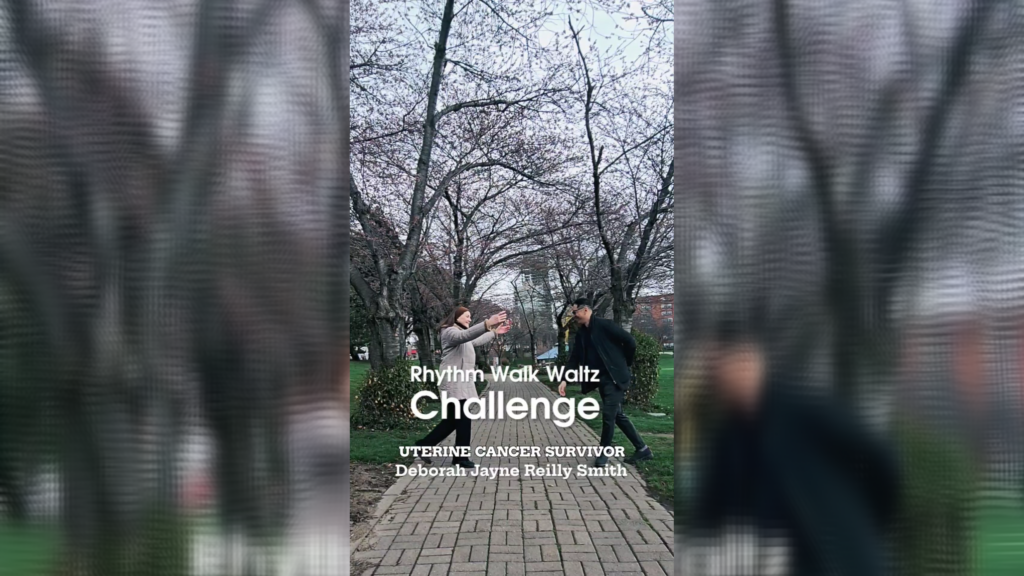
Strength, Dance, Storytelling — and the Meaning of the Moments In Between
There are conversations that inform.
And then there are conversations that stay with you.
Our recent conversation with Deborah Jayne Riley Smith was the latter.
What began as an interview became a reflection on family, illness, caregiving, creativity, and the moments that matter most when life becomes uncertain.

A Connection That Began with Dance
We first met Deborah not long after she arrived in Canada from South Africa.
She came to danceScape with a strong ballroom background and a passion for movement.
What began as a connection through dance gradually became something more.
Over the years, our friendship expanded beyond the dance floor through shared experiences of family, health challenges, caregiving, and community.
Sometimes the people who enter our lives through one doorway become important parts of our story through another.
Deborah is one of those people.
Two Families, One Moment
Many years ago, Robert’s mother was navigating breast cancer.
The family was dealing with uncertainty, grief, and the difficult reality of watching someone you love become increasingly fragile.
At a time when connection mattered most, Deborah invited our father and family to dinner.
It was not a grand gesture.
Just a meal.
A table.
A conversation.
People who cared.
Looking back, that evening reminds us of something simple:
Community is often built through small acts that arrive at exactly the right moment.
Born with Club Feet. Third in South Africa.
Long before becoming a teacher, performer, caregiver, or friend, Deborah was a child born with club feet.
Her feet curved inward and required casting and corrective treatment.
As part of that process, she was introduced to ballet.
The treatment worked.
Movement became possibility.
Later, she pursued ballroom dancing, beginning at age eighteen.
Within a relatively short time, she progressed rapidly through the competitive ranks.
Eventually she turned professional.
In her first year as a professional dancer, she and her partner placed seventh in South Africa.
The following year they achieved third place nationally.
We share this because Deborah’s story did not begin with cancer.
It began with resilience.
It began with someone learning to move through challenge long before she would encounter another one decades later.
When Life Shifts
About a year ago, Deborah received a diagnosis of uterine cancer.
Like many people, the warning signs were subtle.
Fatigue.
Back pain.
The kind of symptoms that can easily be explained away as stress, overwork, or simply getting older.
She was working as a Personal Support Worker and assumed she needed more rest.
The diagnosis arrived on April 1st.
For a moment she thought it was an April Fool’s joke.
It wasn’t.
The news affected not only Deborah but her husband Geoff and their children.
Yet she chose not to tell her children immediately.
They were writing exams.
She didn’t want to distract them.
For three weeks she carried that knowledge alone.
Then one Sunday she invited them for lunch.
After the meal, she gathered them together and shared the news.
The Turning Point: “Mom, It’s Random”
One of the most profound moments in Deborah’s story came after that conversation.
She told her children she felt she must have done something to deserve it.
Many people facing illness ask similar questions.
Why me?
What did I do wrong?
Could I have prevented this?
Her children responded immediately.
“You can’t think like that.”
Her son, studying healthcare and women’s health, said something simple:
“Mom, it’s random.”
Two words.
Yet those two words changed everything.
Not because they removed uncertainty.
But because they removed blame.
Sometimes healing begins when we stop searching for a reason and start focusing on what is in front of us.
What Changes. What Matters.
Experiences like cancer often reorganize priorities.
For Deborah, family moved even closer to the center.
Weekly family dinners became non-negotiable.
Relationships deepened.
Time became more intentional.
During treatment, she challenged her family to prepare something for Christmas.
Music.
Performance.
Creativity.
Anything.
She chose the ukulele.
She sang and played while crying through much of the performance.
The following year the tradition grew.
Piano.
Saxophone.
Cello.
Guitar.
Voices.
Family members contributing their own gifts and talents.
What started as a challenge became a ritual.
A way of creating memories while everyone was still able to create them together.
Movement as Grounding
Throughout treatment and recovery, Deborah continued moving.
Not for performance.
Not for competition.
For balance.
Walking.
Dancing.
Music.
Researching family genealogy.
Activities that gave her mind and body somewhere to focus.
Some days movement meant dancing.
Other days it meant walking around her house.
The scale mattered less than the act itself.
Movement became a reminder that life was still unfolding.
Creativity, Fear, and a Sasquatch
Deborah’s creativity extends beyond dance.
She has appeared in multiple film and television productions, including the recently released film DINOGEIST.
One of her favourite stories involves playing a character who teaches a Sasquatch how to do Tai Chi.
She had never formally studied Tai Chi.
Yet there she was, improvising instructions while standing opposite someone dressed as a Sasquatch.
It sounds absurd.
It is also strangely profound.
Life rarely gives us perfect preparation.
Often we simply step into the scene in front of us, find the rhythm, and keep moving.
The Weight Families Carry
Through her work as a Personal Support Worker, Deborah has witnessed another reality.
The burden illness places on families.
She described watching individuals decline while simultaneously watching their families struggle under the emotional weight of caregiving.
Sometimes the person receiving care is not the only one who needs support.
The entire family does.
This resonates deeply with our own experience navigating our father’s final years.
Medical systems often focus on the patient.
Communities help support everyone else.
Time, Healing, and What Makes It Whole
Modern medicine can extend life.
That matters.
But time alone is not what makes life feel whole.
Connection.
Movement.
Ritual.
Meaning.
These are the things that help transform additional years into lived experience.
Deborah’s story reminds us that healing is not merely biological.
It is relational.
It happens in conversations.
Family dinners.
Shared music.
Walks.
Dances.
Moments of laughter.
Moments of honesty.
The Sakura Project
This is one of the reasons we created the Sakura Project.
Cherry blossoms are often associated with impermanence.
But they also invite us to appreciate what is here while it is here.
Deborah’s story embodies that spirit.
The diagnosis.
The family dinners.
The ukulele through tears.
The music sessions.
The conversations.
These moments matter precisely because they are fleeting.
The danceScape Endowment Fund
Through the danceScape Endowment Fund, established through the Burlington Community Foundation, we hope to make experiences of connection, movement, arts, and community more accessible to others.
Not simply as recreation.
But as meaningful support during periods of transition, loss, healing, and renewal.
Because while medicine may extend time, community helps us live fully within it.
An Invitation
Deborah plans to join us at an upcoming Sakura gathering beneath the cherry blossoms at Spencer Smith Park.
If her story resonates with you, we invite you to join us.
Not for a formal event.
Simply for conversation, reflection, and community.
And perhaps a little gentle Qigong or Tai Chi if enough people would enjoy moving together.
A Final Reflection
Deborah’s story is not ultimately a story about cancer.
It is a story about what happens after.
How we respond to uncertainty.
How we support one another.
How we create meaning.
How we continue moving.
And how, even in difficult seasons, we can still find reasons to gather around a table, share music, laugh, dance, and appreciate the moments while they are here.
Sometimes strength doesn’t look loud.
Sometimes it looks like showing up.
And taking the next step.